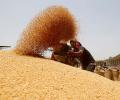
Despite the looming threat of El Nio and drought conditions in several states, the Indian government has set an ambitious foodgrain production target of 373.93 million tonnes (mt) for the 2026-27 crop year, slightly lower than the previous year's actual output but higher than its target.

Karnataka Governor Thaawarchand Gehlot has refused to address the joint sitting of the state legislature, prompting government intervention. The reasons are unclear, but follow similar incidents in other states.

'At a time when there was little awareness of world music, playing western tunes on eastern instruments like the flute and the dholak, blending vocal polyphony with Indian folk and contemporary styles, Salilkaku created a new musical genre in Bengal called Gana Sangeet.'

'Drought in the 1990s was essentially the drought of a poor India.' 'This 2016 drought is of a richer and more water-guzzling India.' 'The severity and intensity of the drought is not about lack of rainfall.' 'It is about the lack of planning and foresight, and criminal neglect.'

States have been told to prepare in advance to counter any impact of an adverse southwest monsoon.
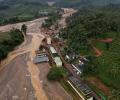
The deadly landslides in Kerala's ecologically fragile Wayanad district were triggered by a heavy burst of rainfall, made 10 per cent heavier by climate change, according to a new rapid attribution study by a global team of scientists.

Billions of dollars pledged by developed nations in climate finance over the last decade remain unused.

The special package assistance would be used to augment irrigation structures in drought-prone areas to address the agrarian distress and drinking water crisis.
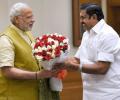
The chief minister also put forth the demand to stop hydrocarbon extraction project in Neduvasal in Pudukkottai district that has attracted large-scale protests recently.

The President talked about demonetisation, electoral reforms and disruptions in Parliament.

What these elections prove beyond any doubt (if ever there was one) that Modi's hold over public mind and Shah's mastery of election management are unparalleled. It doesn't seem likely that they will be matched any time soon in the Indian political scene, reaffirms Shreekant Sambrani.

Malavika Sangghvi gives us fascinating glimpses from Dilip Kumar's life.

'One per cent of wealthy people have been handed over 99 per cent of our nation's resources. The rest are mute, helpless and very frightened spectators to this loot.'

Rahul Khullar's guiding credo was that a civil servant must never lose sight of his client: The little guy. The evil men are those who are decision-makers but abdicate their responsibility of taking decisions, leading people to lose confidence in public institutions.
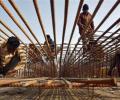
Centre's off-the-record instructions through WhatsApp and a squeeze on funds brought the rural work programme to collapse after a roaring first half of the year.

India's water future remains very bleak. The monsoon season, which once extended to 4 months, is now down to less than 30 days of heavy rain.

'If the almost literally heart-stopping Suez block has any positive outcome, it is to be hoped that it will accelerate the setting up of a fab (perhaps Taiwanese) in India,' asserts Rajeev Srinivasan.
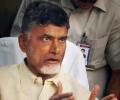
Naidu vowed to hasten the process of securing clearances by industry.

Despite Prime Minister Narendra Modi's tall claims that no one has served nature more than India, some of the steps taken by his BJP government proves that the ground reality is exactly opposite, says Devanik Saha.
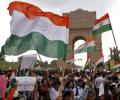
Set up by India's first Prime Minister Jawaharlal Nehru, the Planning Commission brought 12 five-year plans and six annual plans involving fund outlays of over Rs 200 lakh crore in its nearly 65-year-history.

Low consumer demand, a slide in investments and troubles in the banking sector should prompt the government to recalibrate taxes and expenditure. It is also important to ramp up spending on health care and education, says CII president Sumit Mazumder.

The BJP and the Shiv Sena rule the state in coalition, apart from officially being partners in Delhi as well, while also never missing an opportunity to portray each other as a bungler deserving to be dumped.

Sakshi Balani presents an FAQ on the Food Security Bill that was passed by Lok Sabha on Tuesday.

'If the leadership gets wrong information, what results you can expect?'

The Supreme Court and its committees, the two states and the central government must become objective and take the present and not just the past in mind.

'An ardent advocate of nuclear disarmament, Obama may even be secretly heaving a sigh of relief that the NSG is unlikely to reach unanimity of opinion on India's candidature,' says Ambassador M K Bhadrakumar.

'It is a national shame that the only country that enacted a food security act is now better known as the land of farmer suicides. Indian farming can change only if national irrigation policy is implemented in totality,' Dr M S Swaminathan tells Shobha Warrier/Rediff.com

With an aggressive Opposition and unyielding government, important legislation could be the biggest casualty, as details of the helicopter contract surface.

An MP's is a full-time job, so is the BCCI president's. How can Anurag Thakur do justice to both, asks Sudhir Bisht.

The All India Anna Dravida Munnetra Kazhagam's celebrations on amma's return are peppered with possibilities, probabilities and problems of one kind or the other, says N Sathiya Moorthy

'In her insecurity, she destroyed the institutions of democracy.' 'She packed Parliament with her supporters with loyalty being more important than ability; she superseded judges; she corrupted the civil service.' 'She knew how to use people against each other and was quite a master of that.' 'She would do this with calculated skill and in the bargain cause enmity between brothers, split up families.'

President Pranab Mukherjee on Monday addressed the first joint sitting of Parliament as mandatorily required under the Constitution after the general elections. The address is the political, economic and foreign policy road map of the Narendra Modi government and covers virtually all crucial areas.

Maharashtra Finance Minister Sudhir Mungantiwar speaks to Prasanna Zore/Rediff.com.

'In her insecurity, she destroyed the institutions of democracy,' says Khushwant Singh.
